Identifying Digital Acquisition Challenges and Strategic Proposal for a Rental Housing Division
Conducted a comprehensive SEO competitive analysis for the rental housing division of a major housing manufacturer. Analyzed the rental-specific subdirectories of four competing companies across keyword coverage, content strategy, and search journey structure—quantitatively identifying structural challenges in the client's organic acquisition. Independently developed and submitted a strategic proposal based on the findings, which was adopted by the client.

Challenge
The client's rental housing division held almost no organic keyword presence beyond branded searches, leaving a structural gap in reaching potential customers. However, this issue was not apparent from surface-level metrics—it required competitive benchmarking within the same business domain to reveal its severity and structural root cause.
Approach
① Research Design: Business-Unit Comparison Framework
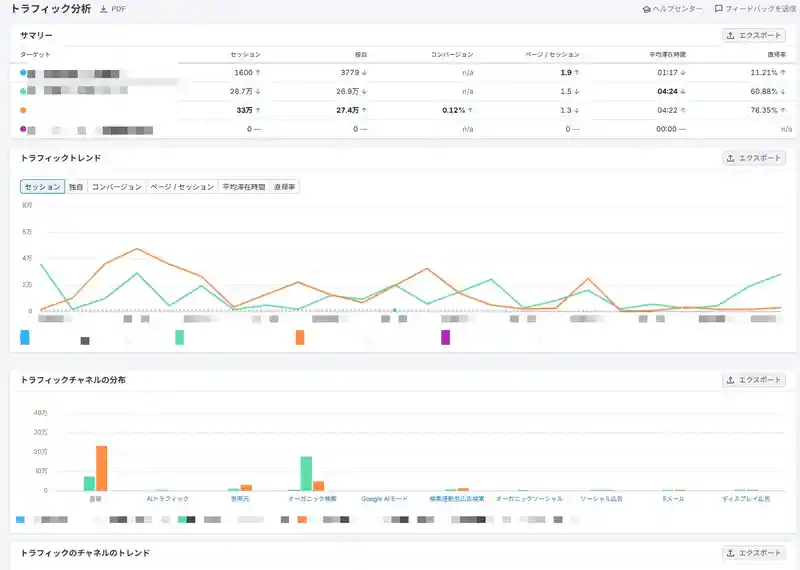
Standard SEO competitive analysis compares entire domains, but rental housing is just one division within each company's portfolio—domain-level comparison would obscure division-specific challenges. I extracted only the rental housing subdirectories of three competitors, designing a framework for precise same-business-unit comparison.
② Quantitative Analysis: Mapping the Full Keyword Gap
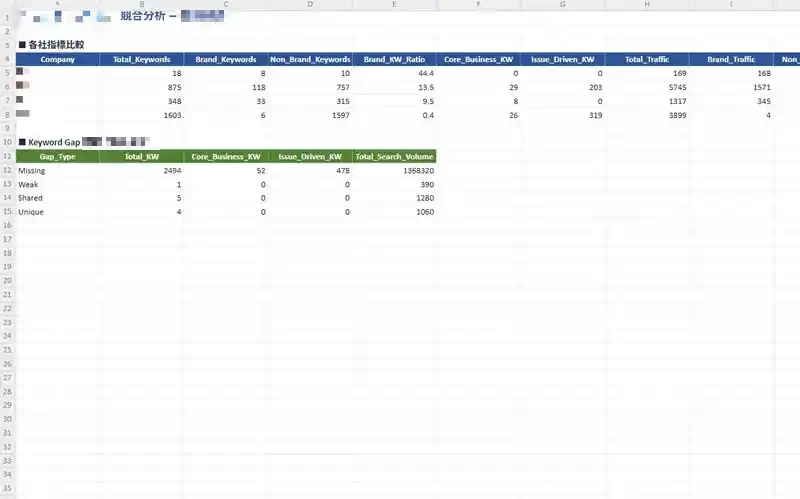
Using Semrush, I compared organic keyword portfolios and estimated traffic across all four companies. The client held just 18 organic keywords versus competitors' 348–1,603. Moreover, 99.4% of the client's traffic came from a single branded keyword—revealing that the issue was not low rankings, but complete non-participation in non-branded keyword competition.
③ Search Journey Analysis: Absence Across All Three Stages
I mapped the rental property management search journey into three stages (market entry research → management method comparison → specialized problem-solving) and analyzed SERP composition for key terms at each stage. The client was absent from all three—high-demand keywords (5,400–33,100 monthly searches) were dominated by government agencies, specialized media, and comparison platforms. A total of 1,455 untapped non-branded keywords were identified.
④ Competitor Content Strategy Typology
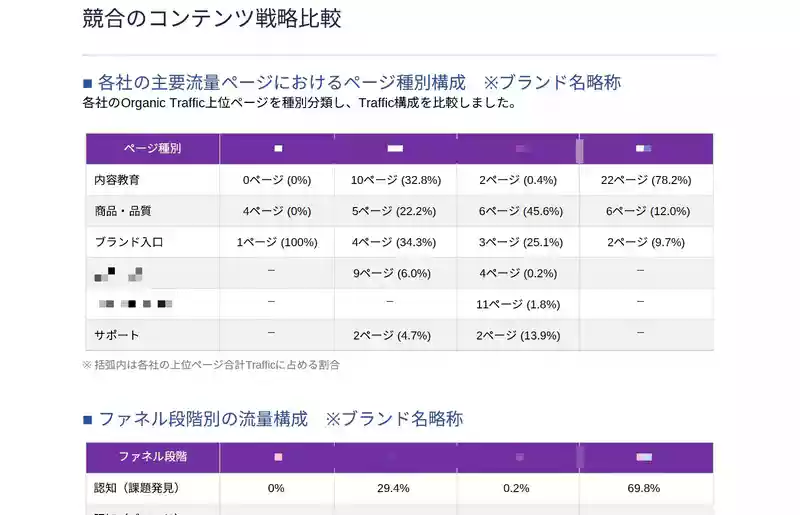
Analyzing the traffic composition of three competitors, I categorized their content strategies into three types: Education Media (tax and asset management knowledge driving the majority of traffic), Balanced (equilibrium between educational and brand content), and Product Page-Driven (traffic through product line depth). The client had a single brand landing page with zero educational content—reframing the challenge from "weak content" to "no content strategy exists."
⑤ From Analysis to Action: Self-Initiated Proposal
The analysis concluded that non-participation in non-branded keyword competition was itself the core challenge, requiring new strategy development rather than incremental improvement. Based on this conclusion, I independently developed and submitted a strategic proposal to the client. The proposal was adopted and evolved into an ongoing engagement.
Results
- Quantitatively identified structural organic acquisition challenges through a four-company comparative analysis
- Visualized 1,455 untapped keywords and mapped absence across all three stages of the search journey
- Self-initiated strategic proposal based on analysis findings was adopted by the client, evolving into ongoing engagement